Wednesday, September 05, 2007

Busy Time and Dreamtime

It’s so tempting. When I was professional and overworked all those years, the little things did not get done: the corner-sweeping details of house and garden. Now with the luxury of time, I am enjoying getting around to some of these in an unhurried way.

But wait! It’s possible to get completely engaged with this taking-care-of-things. I find myself thinking that I could get everything truly in order, when that’s not really my nature or calling. It’s important not to get busy all over again. I need the dreamtime to watch dragonflies and herons at the beaver pond, write poetry, and follow impulse.

Technorati tags: , , , ,

Friday, April 13, 2007

Poems On Retirement

On Retirement—75 Poems, edited by Robin Chapman and Judith Strasser (University of Iowa Press) has just come out.

The collection embraces wonderful, thoughtful poems by people like Ted Kooser, Denise Levertov, Maxine Kumin, Ishmael Reed, Lucille Clifton, Grace Paley—and my "Walking Out"! They muse on changing roles we play, on open spaces of time, on continuing parenting and grandparenting, on our relationships to cities and countryside, on connection and disconnection from those we love.

“This collection is a magnificent entrée to a season of life when time is at once bountiful and limited, is taken and surrendered, has been invested and withdrawn. Some of these voices say that time is leaden and some say it flies, and all are resolute in facing the arc of life’s course.”—Dave Ekerdt, director, Gerontology Center, University of Kansas

Tuesday, January 23, 2007

The Third Half of the Show


The Car Talk guys coined that phrase, “third half of the show,” but as I took a walk today in the winter woods, ice crunching underfoot, I thought Yes, that’s what this time of life feels like. The first part of life, maybe up to age thirty, was growing up and getting educated. The second half was work and family. I’m not sure how it feels to other people, but when I hit 60, I felt a strong sense of coming to the downward arc of my life. It’s not downward in the sense of despair or depression, but it’s clearly moving towards an ending. I am conscious of mortality nearly every day, even though my health is excellent.

I’d never planned for the third half of the show. People tell me it’s time to do the things I’ve always wanted to do and they ask if I am traveling to colorful places. But really, the work of creative writing is an exotic land to me. I don’t so much yearn to see the Amazon as I wish to allow unformed and creative parts to emerge and do their dance.

It’s time to develop my spiritual life, which I see as connection within myself; connection to nature; a new, less goal-oriented way of being with other people; and attunement to the creative process. These inter-connected elements make up the core of my third half life.


Technorati tags: , , , ,

Monday, November 13, 2006

Getting out of busyness, again


How did I do it when I was working 60-hour weeks and trying to have a life? Over the past six weeks I got very busy—well, “very” is relative, but I did help my son roof a cabin, set up a website for the Authentic Movement Community, have houseguests, submit a manuscript to my writing group, join a dance group of differently-abled people, and do some of my own writing. All good things.

Now I’m making the transition back to “my own time.” It’s hard to describe the difference. It’s not like I do nothing, but I have the sense of doing nothing. It’s not like I have endless time, but I attempt to treat it as endless. I stop the lists running in my head (I have one on the kitchen counter for the basics). I notice that voice that keeps asking “What next?” and “What should I be doing?” “Nothing,” I answer the voice.

“Shouldn’t you check email?” “It will wait.”

“Shouldn’t you do errands?” “They can keep.”

I spend time looking out the window at the branches waving in the wind. I suddenly have ideas for three poems—now those are worth the time! I take a walk. I make tea. I write this essay. Tomorrow is a busy day but I have three days in a row after that with no fixed points. What luxury!


Technorati tags: , ,

Monday, September 11, 2006

free fall

(a little meditation on retirement)

as if I deserved it
the whole forest turns
gold, light enters
on a daring slant
leaves flame in the swamp
the beaver dam barely
holds back tons
of shining water

time that was never
mine, is now

in July monotonous
ranks of worker
leaves made sticky
molecules
for mother tree

one October sunrise
the work of holding on
is complete
I hold my breath
to fly between
unclasping and the
anonymous pile below

This poem was published in Peregrine XXIV, 2006

Wednesday, June 14, 2006

The Gift of Time

An old pseudo-folk song said, “Nothing is what you could wish it to be.”

Oh life is a toil and love is a trouble,

beauty will vanish and riches will flee.

Pleasures they dwindle and prices they double

and nothing is what you could wish it to be.

It’s true but it’s not true, and how fortunate I am—no beauty was there to dwindle and I have enough money and I have time. Who knows how much time, but while it’s here it’s mine.

The Last Gift of Time, Carolyn Heilbrun titled her quirky book about the challenges and joys of being in her 60s. She had thought she would commit suicide rather than face that decade but instead she wrote a book about the changes. Then killed herself at 77, when she was still in good health. I was angry at her, knowing her only through her writing—the high-toned murder mysteries and the essays. Why destroy herself when she was well able to negotiate the city she loved and while she still had friends and the infinite horizon of writing to be done? In The Last Gift she wrote of her friendship with May Sarton who—as Heilbrun describes her—was in her old age still feeling angry and deprived because of the recognition she didn’t receive in academic and literary circles. Only millions of actual readers, not the establishment, loved Sarton. There’s definitely a lesson there in taking what you have and being grateful.

But while it’s here, time is mine, that was the thought. My time to pick the ugly larvae off the Asian lilies, to walk in the Quabbin Reservoir wildness, to talk to the cats, to write whatever I choose, to cultivate new friendships. To learn to live in what already is.

Thursday, May 18, 2006

Art and Fear

Among my indulgences is a shelf full of books on writing and creativity. A friend loaned me a wonderful little book called Art and Fear—Observations on the Perils (and Rewards) of Artmaking, by David Bayles and Ted Orland.

One of the major themes running through the book is that artists (including writers) are people who continue. Many people who start creative activities get discouraged, feeling they won’t ever be great or famous, or whatever they think of as achievement. If you keep going, you might or might not do something great; if you quit, for sure you won’t.

Bayles and Orland tell the story of a pottery teacher who divided his students into two groups, one to be graded on the basis of quantity, the other on quality. Those graded on quantity would have all their pots weighed at the end of semester and the weight translated into a grade. Those who were working for quality only had to produce one perfect pot to get an A. At the end of the semester, most of the really good work was done by those who worked on quantity and had the chance to learn from their work.

As Art and Fear says, no one can tell you what it takes for you to keep going. It’s different for every person, though we can learn from one another about some general patterns. So good luck to you in your creative endeavors, and keep on working!


, , ,

Wednesday, April 26, 2006

Now

You can stop waiting.
It has arrived. Whatever
you were waiting for—
the train on Track 5,
springtime,
the moment when
you can be yourself,
the answer to the question
What am I doing?
They all just landed
on your porch, wrapped
in brown paper
delivered with a thud
by the indifferent postman.
You can stop pacing,
you can stop asking
Where will I send this poem?
It’s time to stand at the end
of the walkway
scan the faces
choose your beloved
and hug. Say How are you?
How was the trip?
Are you hungry?
Can I carry your bags?
No more looking
at your watch
checking the schedule
wishing you had planned
a different reunion
with yourself.
Your life has arrived
at the station
now.

Monday, April 10, 2006

What is life about?

Retirement opens up this question all over again, just like adolescence in some ways. For thirty-plus years of college teaching I knew my purpose was to serve students and the institution and to grow in my technical area. Now I don’t want the growth to stop, but it’s in different directions.

Joseph Campbell said these years are about enjoyment of the world. William Bridges, in Transitions, said they are about sharing our wisdom.

But I am most drawn to Jung’s expansive view of development, which he saw as continuing for the whole of a lifetime. He called it individuation—the long, slow maturation of the soul, flowering in creativity and integration of all the parts of a human, including the light and the dark, childhood and archetypes.

I guess, after about a year of retirement, that I feel this segment of life is about all three for me: enjoyment, sharing wisdom, and further integration.

, , ,

Sunday, March 12, 2006

Sunset on the Sea of Cortez, Baja


The joy of unstructured time

I haven’t blogged here for a while—in part because I’m taking my lack of responsibility seriously. I’ve been writing a lot (poetry and memoir), enjoying winter in New England. And I took a wonderful trip to Baja California with my friend Michelle, where we saw mother gray whales and calves and gorgeous scenery. In the evenings we told stories by candlelight.

Back here, I’ve settled into serious chunks of time that are all my own. It’s easy to let the days get clogged with little actions and appointments, but I’m happier when I sweep them clear and let myself drift from thing to thing. It will be interesting to see if my relationship to time shifts some more, but less than one year out from retirement, I’m zealously guarding my freedom.

Thursday, November 03, 2005

The demons at the door

Lately, since I returned from a (really nice) trip to the Southwest, I have been feeling very busy inside. When I try to slow down, I hear a lot of voices inside telling me I should be “on top of things,” should be out saving the world, should be doing something, not slowing down.

Sometimes it’s hard to know when to turn around and confront the voices, and when to keep on moving in the direction of my dreams. This time, I need to face them.

My father was an old Marxist. His voice is with me now as I take time to sit and stare at the maple trees, watching their leaves whirl down to earth. He says that everyone should be politically active all the time, the more the better.

My mother was from a long line of busy, competent women. She was always thinking what to do next. In free time, she did craft projects like beading and embroidery. Sitting watching the trees would seem strange to her. Her voice tells me to look around the house for things that need doing, plan my finances, and keep busy.

It’s as if my personal demons are guarding the door through which I must pass (more than once) to get to my own world. The closer I get to being serious about creating a new more spiritual life, the louder they shout and scream.

Saturday, September 17, 2005

Horizon

What is the color of time?
Thin gray of a stretched-out rubber band
Angry red, rubbed raw by expectations
Solid blue of calendar squares
Umber of anxious memories
Deep green of solitude.

How do I inhale it?
Come inside each mortal cell.
Unlimited time, I say.

After all the years of learning
Time for dinner, time for homework
Time to get up, time to lie down
Go to class
Write the dissertation
Make dinner
Read student papers.


Wait! The wood thrush
The veery’s pan-flute.
Stop breath, listen to distillation of summer.
Time is taffy, warm from the pan,
Drawn to full length by willing hands
Sweeter than ever

Friday, September 16, 2005

Where is this retirement going?

So far I’ve been writing mainly about getting away from the old patterns, breaking the habits of excessive busyness. What am I going towards? Something about spirit and creativity. I want the spaciousness to welcome contemplative moments and hours, the time to sit and watch trees grow and their leaves fall. I want the time to dip in and out of creativity, to sit down at the kitchen table and pull the pastels towards me, or pull up the laptop and make a new poem.

I haven’t yet found my new rhythm. It will take a while. I have a few fixed things in my week: my writing group, two movement groups, and my volunteering to help a Senegalese immigrant with computer skills. Then there are almost-daily hikes, times with friends, and chores. And now I may be organizing a local effort to help a Louisiana town in the aftermath of Katrina.

This is a perfect time to learn how to balance these things in a new way that puts the inner life first.

All my life I’ve done the “necessary” things first, then tried to find time for play and spirit. Now I want to be the dreamy one looking out the window, the doodler who does not hear the teacher’s voice. Put off the projects and do the spirit-work first. I did that today, making two drawings and going on a walk before I started a round of phone calls. Step by step into the unknown.

Wednesday, September 07, 2005

Retiring from school

This week school started without me. After thirty-three years of teaching at Hampshire College, plus five of grad school, two years teaching in Peace Corps, four years at Swarthmore, two years at North Haven High, four at Hamden Hall (where my parents sent me to get out of the violence of a bad school), 2 at Strong School (the one where I had to walk a half mile and cross the steel bridge), and kindergarten plus four grades at the Quinnipiac School just across from my house. Fifty-seven years of discipline, self-discipline, and teaching others how to school themselves—how to get things done, how to inquire, form the question, and follow through.

Now I’m trying to go back through that same gate, get back to wild mind. To take the horses that are so good at staying within the traces and persuade them that it’s OK to kick back, take a side trip, explore the faintest trace. Practice the skill of wandering, of not-knowing, trusting the moment. The discipline of following impulse precisely, lovingly, openly.

Such a lot of unlearning—it’s mostly that attachment muscle inside, the one right up under my diaphragm, the one that says But what are you doing today? Wasn’t there something that someone else needed? Are you accomplishing anything? Doesn’t something in the house need tending? What’s next?

I am slowly (un)learning. Things keep happening. I keep writing, drawing, dancing, being. In a different way, in a different life.

Friday, September 02, 2005

Doing nothing

Doing and not-doing—it’s the question for me just now. There is nothing that I must do, except the obvious things of living: cooking, eating, feeding the cats, taking care of the house. Simply living. Above that, there is no command, no need to plan courses or put out office hours, no meetings or deadlines.

Is it possible to live this way? Is a person worthwhile if she does nothing, allows time to pass, lets the world go by, has no ambition, is not striving for the next thing? It’s not likely that I’ll want to do nothing all the time, but there seems something vital about learning how. It’s a feeling of letting go in the place just above my navel and below my ribs, letting go of the threads of responsibility that have been perpetually knotted there.

Letting go of the illusion that I am necessary—that’s the big one. The feeling, both pleasurable and binding, that I am needed as a part of the fabric of an institution, that there are things I must do, or else. If I am not needed, then who am I?

To contemplate doing nothing, I sit in my rocker and look out at the sugar maple in front of my house, the buckled bark and sturdy limbs. The maple needs to sip water from the earth and do its metabolism, those are basic. The deep green leaves are not ambitious to be anywhere else than on the branches they are tethered to. The whole tree sits there, no tension in its belly, no plans.

I watch the lightly moving leaves. The strings in my belly go slack, I breathe. Then a moment later I am caught up again—what about that volunteer position? Do I need to do anything to prepare for group? Let go again. Nothing needs doing. I can sit here and be. The world will keep turning and churning. I can be all right without doing a thing.

I breathe and let be. Time passes, the wind picks up or dies down, the leaves rustle or become still, the sun moves a bit in the morning sky. My thoughts skitter to things around the house, the roof that needs patching, the dishes unwashed.

What is the necessity so huge that it must always be served? What beast is this that demands total devotion? Not enough to do the necessary things, this beast requires attention at every instant of the waking day. Plan. Think. Look ahead. Don’t stop. Keep busy, if not in body at least in mind.

If you don’t, you might realize how short life is. If you don’t, you might feel the poignancy of it. If you stop thinking, you might simply be alert to the world as it is. This would make the beast very angry.

Tuesday, August 30, 2005

Running Wheel

There you are, the gerbil of accomplishment
running on your wheel
inside my chest. Round and round
the wheel goes, no end to it.
The gerbil stays in place, panting,
faster, faster. There are gaps
in the wheel, the gerbil could leap off
but it does not.
I put my finger on the wheel.
I reach in and take you in my hand.
Golden one, curl up here.
Then we’ll go out to the garden.
Do you like to eat dahlias?
Carrots, parsley, basil?
Little one, the world is larger
than you know.

Monday, August 29, 2005

Walking Out

Walking Out

From bolted wooden desks
to electron-etched screens,
fifty-five years in school.
Early lessons well-learned—
Color between the lines.
Dead white men are
the poets. You’ll be good
at science, it doesn’t need
much imagination.
In my turn to teach, I schemed
to bring students power and joy,
danced molecules, embraced laughter.
Loving my work, I drop it now
on the floor like a still-warm
shirt, walk out the kitchen door
into the goldenrod meadow
already humming with bees.
The doe was here last night—
see the hollow where she slept.

This poem was published in On Retirement--75 Poems, edited by Robin Chapman & Judith Strasser (2007, University of Iowa Press)

Sunday, August 28, 2005

Serving their dreams

A couple of weeks ago I turned in my keys: office, copy room, lab, and outside door. No more Xeroxing at night or on weekends. No mailbox—I’ll have to call and see what they are doing with my first class mail. No office where I wait for students. No more lists of things to do for them. For thirty-three years I’ve been serving other people’s dreams. A fine thing to do, to find out what these young people aspire to, to coach and coax and kick and cajole, then watch them walk across the stage to cheers and whistles, vanish into the world. One after another, hundreds of them, for more than a generation. They are aging now, the first of them graying too. They have realized the dreams, and the limitations.

Somewhere along the line, my dreams got reduced to theirs, or expanded; my dream simply became serving theirs. I grew expert at seeing beneath the surface—to see the goldfish lurking in the ponds of the quietest minds, to see the patterns connecting the wildest sets of fantasies. But the idea of having my own whirling exploding expanding firework of a dream—where did that go, if I ever had it? Perhaps I always was too modest and realistic, even from age twenty. Get married. Go on to grad school, get the degree, practice a profession, raise a child—none of these smacks of fireworks. None of these whirls and spits sparks.

It must be time to regress and let the wild curls of fantasy expand. It’s time to roll downhill faster and faster. It’s time to look into the pond of my own soul and feed the goldfish regularly. Time to hop out of the pond onto dry land and flop around, or jump into it and flail in the shallows, time to try the ungainly, unlikely combinations. Time to be ungainly and unlikely. I don’t have to be a professor, I don’t have to be a professional. I get to play again.

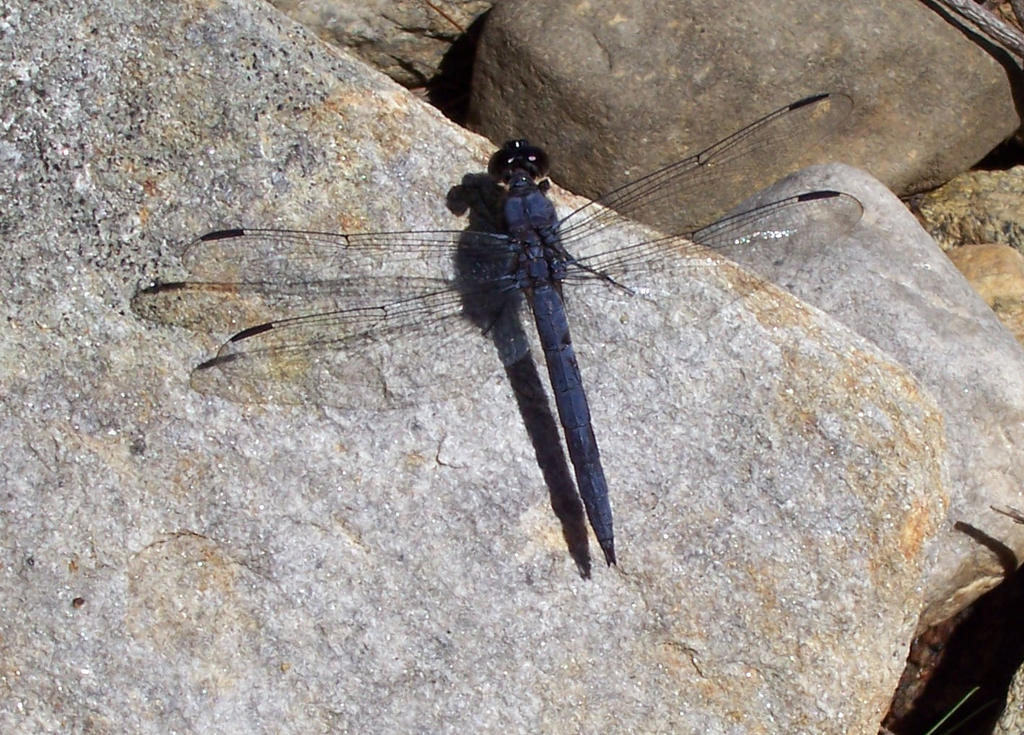
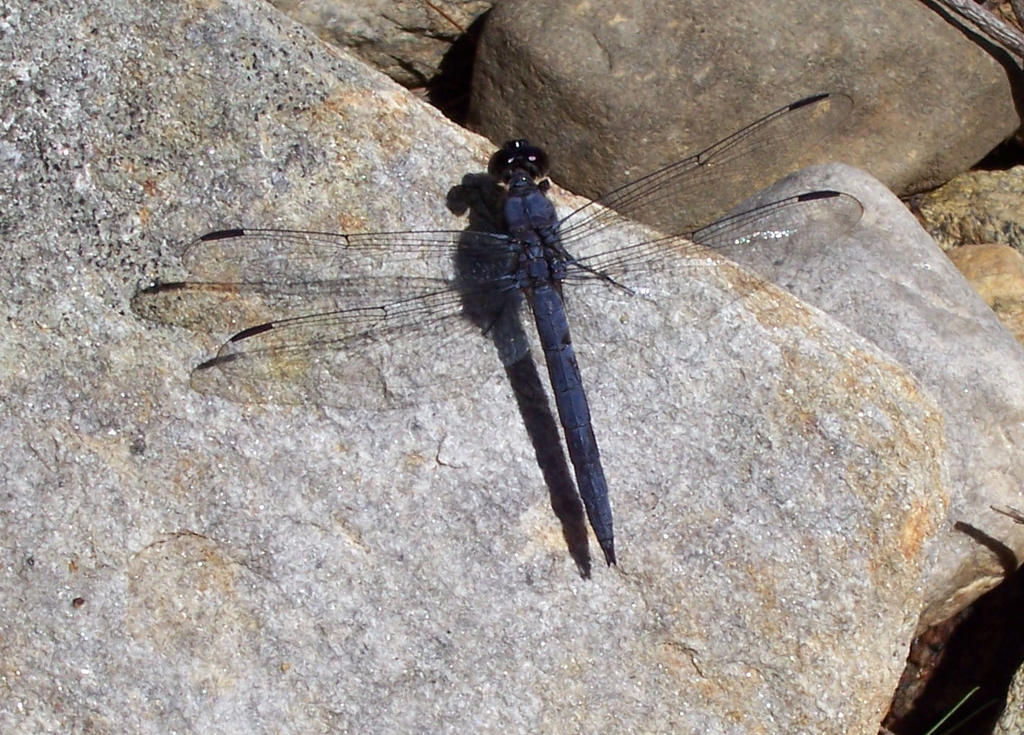
Slaty skimmer at Quabbin


One of my new passions is dragonflies. I took a short field course on them, and now I see them everywhere.